
This article first appeared here
The U.S. Army wrapped up a live-fire counter-drone exercise in Lithuania in mid-May, and the headline out of Anduril’s marketing department was straightforward: the software worked, the targets died, and the kill chain ran on Lattice.
What that means in practice deserves more scrutiny than Anduril’s press team is inclined to provide.
The announcements
In November 2025, the Army selected Anduril Industries to serve as the software backbone of its Integrated Battle Command System Maneuver program — IBCS-M — establishing Lattice as the next-generation fire control platform for counter-UAS missions across the force. Less than six months later, Flytrap 5.0, a live-fire exercise conducted in Lithuania with U.S. and allied forces, served as the program’s public coming-out event.
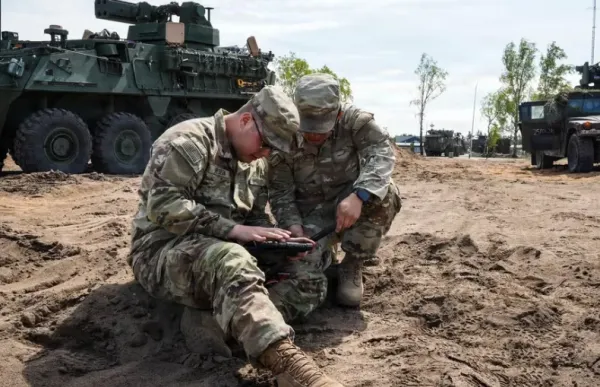
The exercise integrated more than 30 sensors and weapons systems into a single Lattice-powered command-and-control network. Twelve of those systems were evaluated by the Army for their contribution to layered air defense. The exercise culminated in live-fire intercepts — targets detected, tracked, and destroyed through what Anduril calls “autonomy-enhanced fire control.”
The company called it a success. The Army has not publicly disputed that characterization.
The IBCS-M selection follows a demonstration at Yuma Proving Grounds in which Lattice integrated a previously undisclosed sensor and weapons system within hours, executed live-fire intercepts with four kills out of four attempts, and demonstrated what Anduril described as “kill-chain optimization” and “distributed tracking.” U.S. Army CTO Alex Miller, quoted in Anduril’s own press release, said the system must support forces “on the move” without waiting for outside assistance to solve integration problems in the field.
The Army is not waiting. Lattice is already in the field.
What Lattice actually is
Lattice is Anduril’s artificial intelligence-powered command-and-control software platform. It ingests data from radars, electromagnetic sensors, and other detection systems, fuses that data into a unified threat picture, and executes what the company calls the “full CUAS kill chain” — from initial sensor detection through weapons cueing and target destruction.
Anduril describes Lattice as an open architecture, meaning third-party sensors and weapons can be plugged into the platform through a software development kit. During Flytrap 5.0, industry partners with no prior exposure to Lattice integrated their systems into the platform in real time, collapsing what the company says would otherwise be weeks or months of integration work into hours.
That speed is the product’s central selling point. Counter-drone engagement windows, Anduril notes, are often compressed to seconds. Lattice is designed to operate within those windows — faster than traditional command structures, faster than manual processes, and, in the company’s explicit framing, faster than human decision loops.
The dangers no press release will name
That last phrase — faster than human decision loops — is where the promotional language ends and the serious policy questions begin.
Lattice does not merely assist human operators. It is architected to compress or replace the deliberative space between detection and lethal action. Anduril’s own materials describe a system that “automates fire control,” reduces “operator load,” and executes kill-chain decisions at “machine speed.” The system is explicitly designed for environments where, in the company’s framing, human reaction time is the vulnerability.
The logical endpoint of that design philosophy is a weapons system that acts before a human can meaningfully intervene — or one in which human authorization becomes a procedural checkbox on a decision the software has already effectively made.
That is not a hypothetical. It is the architecture.
Lattice’s open SDK means the platform can be connected to virtually any sensor or weapons system a third-party developer integrates. During Flytrap 5.0, more than 30 systems were plugged in. The Army evaluated 12. As the platform scales — and the IBCS-M contract is explicitly designed to scale it across the force — the number of weapons systems operating under Lattice’s automated fire control will grow. Each new integration expands the attack surface, both in the cybersecurity sense and in the more fundamental sense of how many ways the system can initiate lethal action.
The legal framework governing autonomous weapons has not kept pace. International humanitarian law requires that lethal force be applied with human judgment capable of distinguishing combatants from civilians, assessing proportionality, and accounting for context that no sensor fusion platform currently captures with legal sufficiency. Anduril’s materials make no mention of how Lattice satisfies those requirements. The Army’s public statements do not address it either.
There is also the question of accountability. When Lattice-enabled fire control prosecutes a target, and that target turns out to be wrong — a misidentification, a spoofed signal, a civilian vehicle with an electromagnetic signature that tripped a threshold — who is responsible? The operator who approved a firing solution that the software generated in seconds? The Anduril engineers who wrote the kill-chain logic? The Army program managers who certified the system?
The company’s answer, embedded in its architecture, is that the system is accurate enough that the question need not be foregrounded. Four for four at Yuma. Successful intercepts in Lithuania.
For now.
The Ohio context
Anduril received $848 million in Ohio state subsidies in 2025 — 99 percent of all such subsidies issued nationally that year — to build Arsenal-1, a five-million-square-foot manufacturing campus in Columbus. Ohio taxpayers are substantially invested in Anduril’s growth. The debate over what, precisely, that investment is producing has not matched the scale of the public commitment.
Lattice is now the Army’s counter-drone command-and-control brain. It is designed to kill faster than humans can decide. It is scaling across the force. And the policy architecture required to govern it is nowhere close to keeping up.